

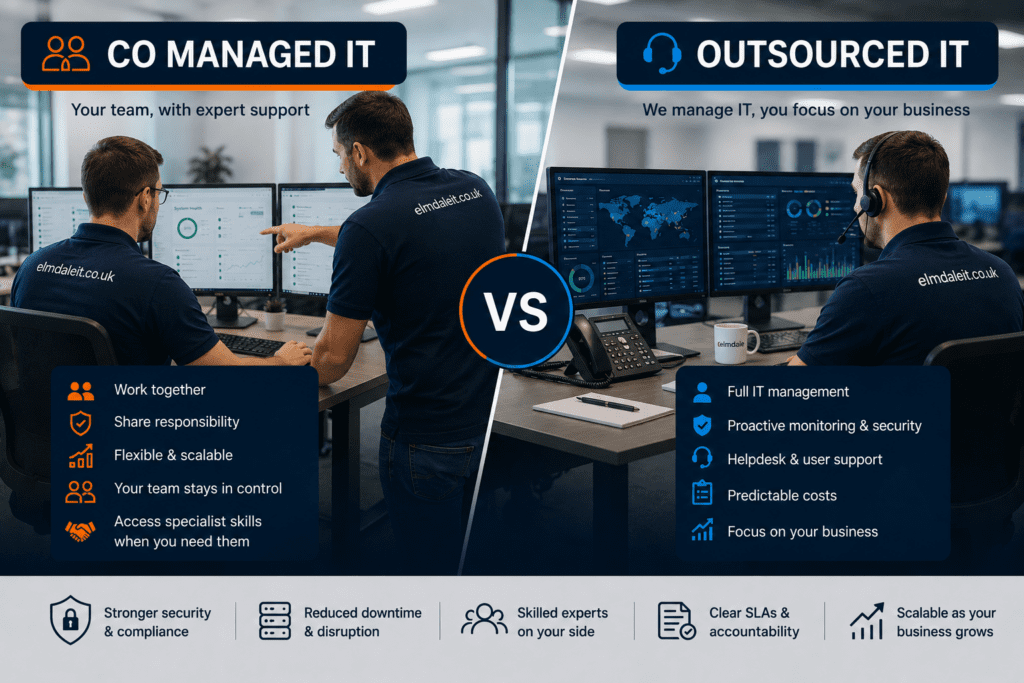
When systems are under strain, tickets are piling up and cyber risks are getting harder to manage, the question is rarely whether you need support. It is whether co managed IT vs outsourced IT is the better fit for how your organisation actually works. That choice affects not only cost, but also control, response times, accountability and how confidently you can plan for the future.
For many organisations, this is not a purely technical decision. A school may have an experienced network manager who needs extra help during holidays, migrations or security projects. A growing business may have no internal IT team at all and simply need a dependable external partner to keep everything running. Both situations need support, but not the same support model.
What is the difference between co managed IT and outsourced IT?
Co managed IT is a shared model. Your in-house team keeps ownership of some responsibilities, while an external provider supports the areas where extra capacity, tools or specialist expertise are needed. That might mean handing over cyber security monitoring, Microsoft 365 administration, backup management or third-line support while your internal staff deal with day-to-day user issues and local knowledge.
Outsourced IT is different. In that model, the external provider becomes your main IT function. They take responsibility for support, monitoring, maintenance, advice and often strategic planning as well. This tends to suit organisations that do not have an internal IT department, or those that no longer want to carry the overhead of managing one in-house.
Neither approach is automatically better. The right choice depends on your current capability, your appetite for hands-on control and how much resilience you need from your support arrangement.
Co managed IT vs outsourced IT: where co managed support works best
Co managed IT usually suits organisations that already have some internal expertise but need reinforcement. That internal team may be knowledgeable, but stretched. They may be firefighting user requests and struggling to make time for security improvements, infrastructure upgrades or strategic planning.
In those cases, co managed support adds breathing room. It allows your staff to focus on the areas where they add most value, while a specialist provider fills the gaps. That can be especially useful in schools, multi-site organisations and growing businesses where internal IT knows the environment well but lacks the bandwidth to cover every discipline.
It also helps where specialist knowledge is needed only some of the time. A small internal team may not need a full-time cyber security analyst, cloud architect or telephony specialist on payroll. With a co managed model, those capabilities are available when needed without the cost of building a much larger internal department.
The trade-off is that co managed IT relies on clear boundaries and good communication. If roles are vague, tasks can be duplicated or missed altogether. Responsibility for patching, approvals, escalations and user communication needs to be agreed in practical terms, not left as assumptions.
When outsourced IT makes more sense
Outsourced IT is often the cleaner option for organisations that want one accountable provider managing the whole picture. If you do not have in-house IT, or if your internal capacity is limited to basic administration, a fully outsourced model can reduce complexity and give you a clearer support structure.
This approach can also make budgeting more predictable. Instead of recruiting, training and retaining multiple in-house specialists, you gain access to a broader team under a service agreement. That usually includes helpdesk support, proactive monitoring, maintenance, advice on replacements and support for projects.
From a leadership perspective, outsourced IT can be easier to govern. There is a single support relationship, clearer service levels and less dependence on one or two internal individuals. If a member of staff leaves, your operational IT knowledge is not walking out of the door with them.
That said, full outsourcing is not the right fit for every organisation. Some teams prefer to keep direct internal control over systems, suppliers and technical priorities. Others have niche applications or operational processes that are closely tied to internal knowledge. In those cases, full outsourcing can feel too distant unless the provider takes time to understand the organisation properly.
Cost is only part of the decision
It is tempting to compare co managed IT vs outsourced IT on monthly spend alone, but that can be misleading. The more useful question is what cost you are trying to avoid.
If your internal team is overwhelmed, the hidden costs may already be showing up as delayed projects, inconsistent patching, weak documentation or rising cyber exposure. Co managed IT can be cost-effective because it strengthens your existing team without replacing it.
If you have no dependable in-house capability, the hidden costs may be downtime, poor user experience, unsupported systems and reactive decision-making. In that case, outsourced IT may offer better value because it replaces uncertainty with a structured service.
A cheaper support model is not a saving if it leaves serious gaps in resilience or security. Equally, paying for full outsourcing when your internal team is strong and well-led may create unnecessary overlap. Good IT planning looks at operational risk as much as budget.
Security, compliance and business continuity
This is often where the difference becomes more obvious. Co managed IT can be highly effective for security if your internal team is capable and the provider is covering specialist areas such as monitoring, backup testing, policy support or Cyber Essentials preparation. It gives you flexibility while still strengthening protection.
Outsourced IT can offer stronger consistency where internal resources are limited. A good provider will standardise patching, endpoint protection, user access control, backup routines and disaster recovery planning across your environment. That consistency matters, especially for organisations that handle sensitive data or need to demonstrate due diligence.
The key point is accountability. Who is responsible for reviewing alerts? Who checks backups can actually be restored? Who owns leaver processes and access changes? In a co managed arrangement, those responsibilities must be split carefully. In an outsourced model, they should be clearly owned by the provider, with reporting that keeps you informed.
The human side matters more than many expect
Technology support models succeed or fail on relationships as much as technical skill. Co managed IT only works well if your provider respects your in-house team and complements them rather than competing with them. Your staff should feel supported, not sidelined.
Outsourced IT requires trust of a different kind. Your users need confidence that help will be responsive, practical and easy to deal with. Decision-makers need straightforward advice in plain English, not jargon or finger-pointing.
This is why local responsiveness can be so valuable. Remote tools are essential, but there are times when on-site support, face-to-face planning and a provider who understands your region and working environment make a real difference. For organisations across Berkshire, Hampshire, Surrey, Dorset, Wiltshire and London, that local accountability is often part of what turns IT support from a supplier relationship into a dependable partnership.
How to choose between co managed IT and outsourced IT
Start with an honest view of your current position. Do you have internal IT capability that is strong but stretched, or are you relying on a patchwork of suppliers and willing staff? Are your biggest problems capacity, specialist expertise, continuity or strategic direction?
Then look at ownership. If you want to retain internal control and already have trusted technical people in place, co managed support may be the more natural step. If you want a single partner to take responsibility for support, maintenance and guidance, outsourced IT is usually the better route.
It also helps to think ahead. A business that is growing quickly may start with outsourced IT and later build an internal function. Another organisation may begin with co managed support and expand that relationship as infrastructure becomes more complex. These models are not fixed forever. The best arrangements evolve with your needs.
At Elmdale IT Services, that is often the most practical conversation to have first – not which label sounds better, but which structure gives your organisation the right mix of support, control and resilience.
The right model is the one that removes risk without adding friction
If your internal team is capable but overloaded, co managed IT can give them the depth and cover they need. If you need a complete, accountable support function, outsourced IT can bring clarity and consistency. The better choice is the one that fits your organisation as it is now, while still giving you room to improve security, reduce downtime and make better technology decisions over time.
A useful next step is to stop thinking in service labels and start thinking in responsibilities. Once you are clear on who should own what, the right support model tends to become much easier to see.