
A slow response to a support ticket used to be the main frustration. Now, the bigger risk is much broader: cyber threats that move quickly, systems that do not talk to each other, remote teams relying on patchy setups, and leadership teams expected to make technology decisions with limited time and in-house expertise. That is why the future of managed IT services is not just about fixing faults faster. It is about giving organisations a dependable technology partner that helps them plan well, stay secure and keep operations running without unnecessary disruption.
For businesses, schools and established organisations, that shift matters. IT is no longer sitting quietly in the background. It affects productivity, communication, compliance, customer service and business continuity. Managed services are changing to reflect that reality.
What the future of managed IT services looks like
The traditional managed service model focused heavily on monitoring devices, maintaining servers, applying updates and responding when something broke. Those foundations still matter, but they are no longer enough on their own. Organisations now need IT support that combines day-to-day reliability with strategic guidance.
In practice, this means managed IT providers are becoming more involved in decisions that shape the wider organisation. That could include advising on Microsoft 365 usage, supporting a move to cloud services, reviewing wireless performance across a site, improving telephony for hybrid teams or strengthening backup and disaster recovery plans. The provider is no longer simply a helpdesk. They are expected to understand how the organisation works and recommend technology that suits it.
That also means generic packages will become less useful. A school has different security, safeguarding and connectivity needs from a professional services firm. A growing business with multiple sites has different priorities from a long-established office looking to modernise ageing systems. The future belongs to managed IT services that are tailored around the organisation, not forced into a standard template.
Security will sit at the centre of every service
Cyber security is already a major concern, but it will become even more central to managed support over the next few years. That is partly because attacks are becoming more sophisticated, but also because the attack surface is wider. Staff work from different locations, rely on cloud platforms, access systems from mobile devices and use a growing range of software tools. Each change creates another point that needs to be protected.
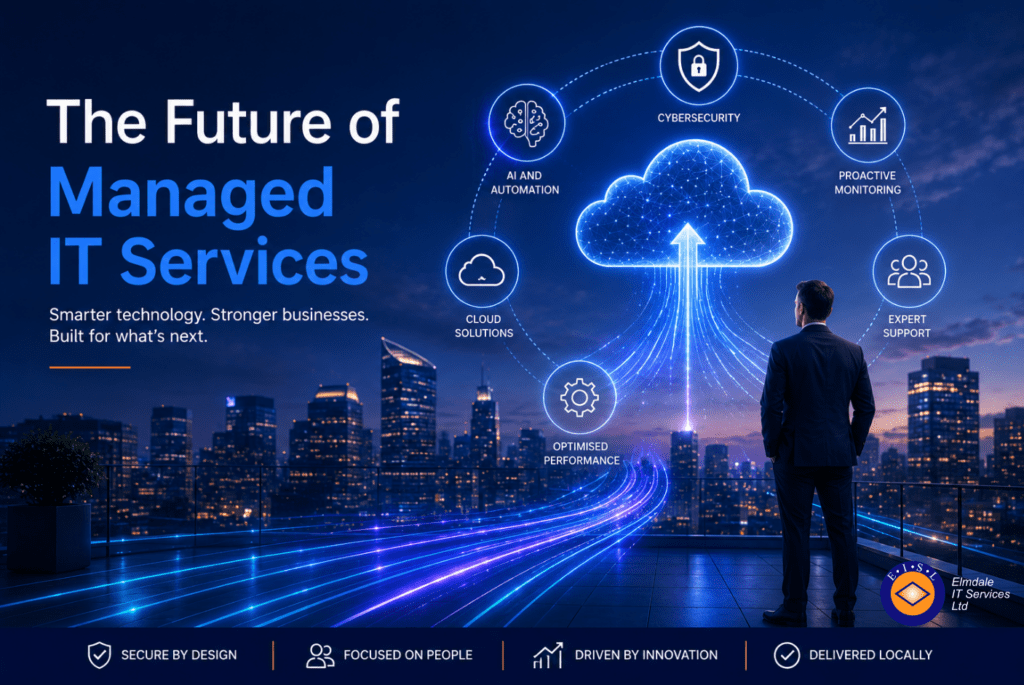
In the future of managed IT services, security will not be treated as an optional extra or a separate line on a proposal. It will be woven into the service from the start. Monitoring, patch management, access controls, email protection, backup, endpoint security, user awareness and recovery planning all need to work together.
There is also a growing expectation around standards and evidence. More organisations are being asked by customers, suppliers and insurers to show that they take cyber security seriously. Support with frameworks such as Cyber Essentials is therefore becoming more valuable, particularly for organisations that need practical help rather than pages of technical advice.
The trade-off is that stronger security can sometimes introduce more steps for users. Multi-factor authentication, stricter permissions and tighter device controls are not always popular at first. A good managed provider will explain why those controls matter and implement them in a way that protects the organisation without making everyday work harder than it needs to be.
Automation will grow, but people will matter more
Automation is already changing IT support. Routine checks, patch deployment, system alerts and some forms of issue resolution can now be handled more efficiently than before. Artificial intelligence will push that further, helping providers spot patterns, predict failures and resolve straightforward problems earlier.
That is good news for clients, because it should reduce downtime and improve consistency. It can also free up technical teams to focus on more valuable work such as planning, security improvements and user support.
But there is a common misunderstanding here. More automation does not mean less need for human input. In fact, the opposite is often true. As systems become more connected and business reliance on technology increases, organisations need clearer advice, better communication and more informed decision-making. They need someone who can explain the practical impact of a system change, help prioritise investment and respond calmly when there is a problem.
A scripted answer is rarely enough when a school is dealing with a network outage or when a business is weighing up whether to migrate key services to the cloud. The future of managed IT services will be shaped by automation in the background and experienced people at the front.
Cloud, communications and continuity will keep converging
Many organisations no longer think of IT in separate boxes such as servers, phones, files and offices. Staff simply need to work effectively, wherever they are. That is why cloud services, collaboration tools, connectivity and telephony are becoming more closely linked within managed support.
A modern IT partner needs to look at the whole picture. If a team is using Microsoft 365, the conversation should not stop at licences and setup. It should include security settings, document access, backup, user training and how the platform supports day-to-day operations. If a business is replacing an older phone system with VoIP telephony, the decision should also factor in broadband resilience, network performance and remote working needs.
Business continuity is part of this wider picture too. Backup and disaster recovery used to be seen as something you hoped never to use. Now they are central to operational resilience. The question is no longer just whether data can be restored. It is how quickly people can get back to work, what systems matter most and what level of interruption the organisation can realistically tolerate.
That is where managed services are becoming more commercially aware. Good advice is not only technical. It should reflect how the organisation operates, where the risks sit and what level of resilience is proportionate.
Local support will remain a real advantage
Technology may be cloud-based, but support still benefits from local accountability. That will remain true in the years ahead, especially for organisations that value fast on-site help, a familiar contact and practical guidance from people who understand their environment.
For many businesses and schools, there is a clear difference between speaking to a provider who knows the site, the staff and the history of previous issues, and speaking to a remote call queue that starts from scratch each time. Remote tools are essential and highly effective for many tasks, but they do not replace the value of responsive, local service when an issue needs hands-on attention or when decision-makers want a proper discussion about next steps.
This is especially relevant when planning upgrades, improving wireless coverage, reviewing cyber security or supporting office moves and infrastructure changes. In those situations, context matters. A provider who takes the time to understand the organisation can give more useful advice than one delivering a standard response from a distance.
Strategy will become part of the service, not an add-on
One of the biggest changes ahead is that organisations will expect more than reactive support and technical maintenance. They will want an IT partner who helps them plan.
That does not mean every organisation needs a complex digital transformation programme. Often, it is about straightforward questions answered well. Which systems should be replaced first? Is the current backup arrangement fit for purpose? Can cyber security be improved without slowing everyone down? Is the business getting proper value from Microsoft 365? Is the phone system holding the team back? What happens if a key member of staff leaves and no one knows how critical systems are set up?
Strategic input is becoming more important because technology decisions now have wider consequences. Poor choices can create cost, risk and disruption for years. Sensible planning can reduce all three.
This is where a managed provider should act as a steady adviser, not just a supplier. At Elmdale IT Services, that means helping clients make practical decisions in plain English, with support shaped around the way their organisation actually works.
What organisations should look for next
As managed services continue to evolve, the right provider will be the one that balances technical capability with clear communication, security awareness and a genuine understanding of operational needs. Tools and platforms matter, but so does judgement. So does responsiveness. So does the ability to explain options without burying people in jargon.
The most useful question is not whether managed IT services will become more advanced. They will. The better question is whether your current support arrangement is moving in the same direction as your organisation.
If your IT provider still feels focused only on tickets and break-fix issues, there may be a gap opening up. The organisations that will be best placed over the next few years are the ones with support that is proactive, security-led, commercially sensible and tailored to the way they operate. Technology will keep changing. What matters is having a partner who helps you change with it, confidently and at the right pace.