

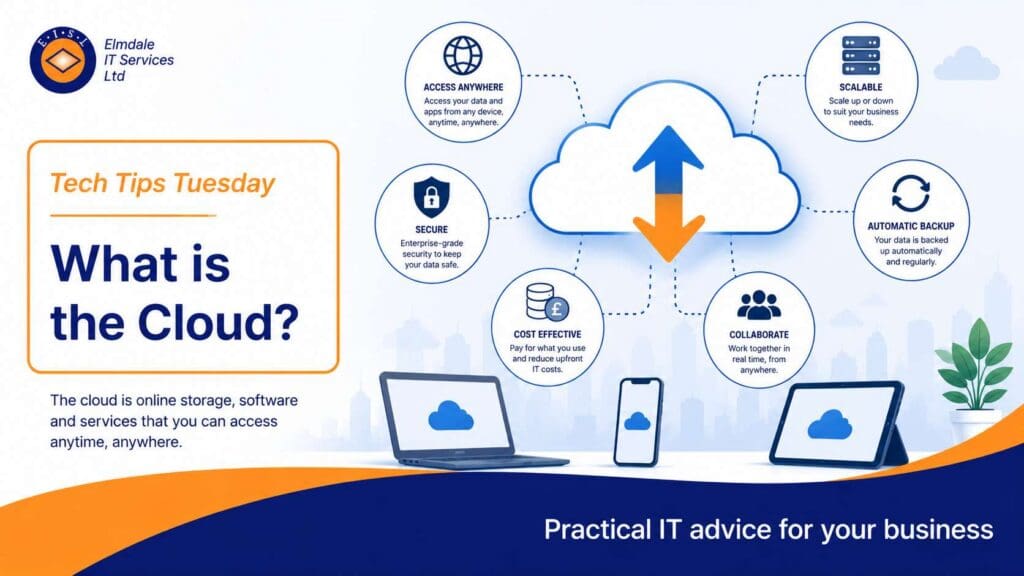
“The cloud” is one of those phrases that gets used all the time in IT.
Cloud storage. Cloud email. Cloud backup. Cloud servers. Cloud phones.
But what does it actually mean?
In simple terms, the cloud means using computing services that are hosted in secure data centres and accessed over the internet, rather than everything being stored or run on a server in your own building.
Everyday examples of cloud services
You probably use the cloud already without thinking about it.
Examples include Microsoft 365 email, OneDrive, SharePoint, Teams, Google Drive, online banking, hosted phone systems, cloud backup, and web-based business applications.
Why businesses use the cloud
The cloud can offer many benefits, including easier remote working, better collaboration, reduced reliance on ageing servers, improved resilience, scalable storage, access from multiple locations, and better integration with modern security tools.
For many businesses, cloud services make IT more flexible and easier to manage.
The cloud still needs managing
A common mistake is thinking that moving to the cloud means you no longer need IT support.
That is not true.
Cloud systems still need to be configured, secured, monitored, backed up, and managed properly.
For example, Microsoft 365 is powerful, but it still needs the right security settings, user permissions, MFA, backup policies, device controls, and sharing rules.
Cloud does not mean risk-free
The cloud can improve resilience, but it does not remove every risk.
Businesses still need to think about access control, password security, MFA, data backup, user permissions, device security, compliance, and staff training.
Steve’s tip
Do not move to the cloud just because everyone else is doing it.
Start with a proper plan.
Look at what systems you use, how staff work, what data you hold, what security is needed, and how the business would recover if something went wrong.
Final thought
The cloud can be a brilliant step forward for businesses, especially when it is planned properly.
It can improve flexibility, security, collaboration, and resilience. But it should never be treated as a simple “upload everything and hope for the best” project.
Elmdale IT can help businesses plan, migrate, secure, and manage cloud services such as Microsoft 365, SharePoint, OneDrive, Intune, Azure, and cloud backup.