
A customer asks how their data is protected. A school needs to demonstrate that staff accounts are properly controlled. A tender asks for evidence of cyber security. These are the moments when IT compliance frameworks move from a policy document to a practical business priority.
For organisations across Berkshire, Hampshire, Surrey, Dorset, Wiltshire and London, compliance should not mean buying a large binder of templates or adding unnecessary process. It should mean understanding your risks, putting sensible controls in place and being able to show that those controls work. Done well, it improves security, supports continuity and gives leaders greater confidence in the way technology is managed.
What are IT compliance frameworks?
IT compliance frameworks are structured sets of requirements, controls or best practices that help an organisation manage information, technology and cyber risk. Some are legal or contractual necessities. Others are voluntary standards that provide a recognised way to demonstrate good practice.
A framework typically covers areas such as access to systems, password and account management, data protection, device security, backups, incident response, supplier controls and staff awareness. It gives an organisation a clear benchmark: what should be in place, who is responsible and what evidence can prove it has been done.
The distinction between compliance and security matters. Compliance is not a guarantee that an organisation will never suffer a cyber incident. A business can tick every box and still face a convincing phishing attack or a new software vulnerability. However, a suitable framework creates discipline around the controls that reduce the likelihood and impact of an incident. It also makes weaknesses easier to identify before they become costly problems.
Which IT compliance frameworks may apply?
The right choice depends on your sector, the data you handle, the expectations of customers and the scale of your organisation. A small professional services firm will not need the same level of formality as a larger organisation working with public-sector contracts. Equally, a school has safeguarding and education-specific responsibilities that deserve proper consideration alongside general cyber security.
Cyber Essentials
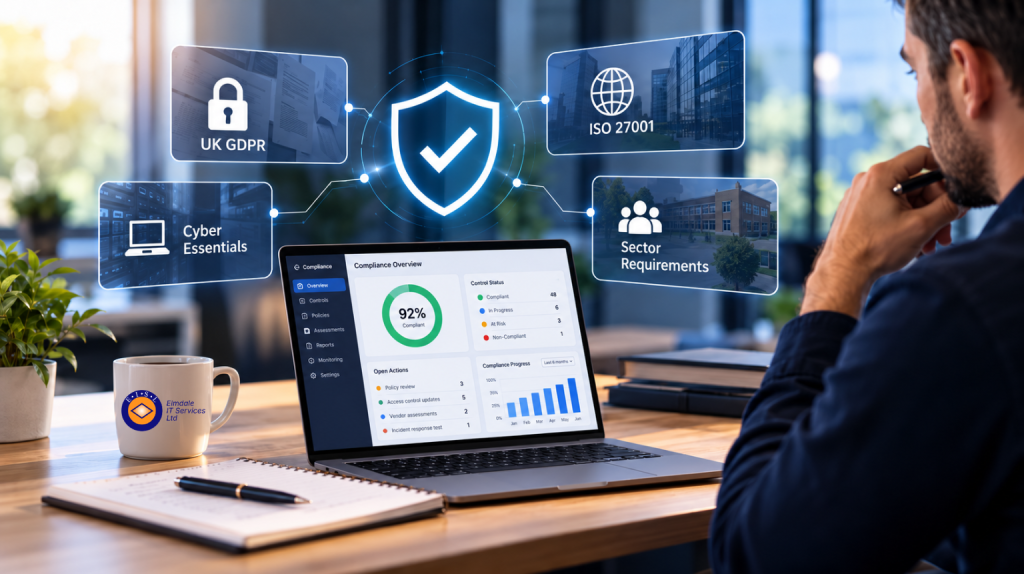
Cyber Essentials is often a practical starting point for UK organisations. It focuses on a defined set of technical safeguards, including firewalls, secure configuration, access controls, malware protection and patch management. It is widely recognised, can be required for certain contracts and helps organisations address common causes of cyber compromise.
Its strength is clarity. For many small and mid-sized businesses, it provides a manageable route to improving cyber hygiene without creating a heavy administrative burden. The trade-off is that it does not cover every aspect of information governance, supplier risk or business processes in the depth of a broader management standard.
ISO 27001
ISO 27001 is an international standard for an information security management system. It is designed to help organisations identify information risks, select appropriate controls and continually review how those controls perform. It is particularly relevant where clients, regulators or procurement teams expect formal, independently audited assurance.
ISO 27001 can bring significant commercial value, especially for organisations handling sensitive data or bidding for larger contracts. It does require leadership commitment, documented processes and ongoing maintenance. Certification should therefore be approached as a business improvement programme, not simply a badge to obtain.
Data protection and UK GDPR
UK GDPR is legislation rather than a voluntary framework, but it has a direct impact on IT decisions. Organisations that process personal data must use appropriate technical and organisational measures to protect it. In practice, that can include multi-factor authentication, encrypted devices, controlled access, secure retention and deletion processes, and a tested response plan for potential data breaches.
Technology alone will not achieve data protection compliance. Your privacy information, lawful basis for processing, staff procedures and third-party agreements all matter. IT should support those responsibilities by making data easier to protect, locate and manage.
Sector and customer requirements
Schools, healthcare providers, finance businesses and organisations working within supply chains may need to meet additional requirements. Customers may also impose security questionnaires, minimum standards or contractual audit rights. These requests can feel inconsistent when they arrive one at a time, but they often ask for evidence of the same core controls: secure systems, managed access, reliable backups and clear accountability.
Rather than treating every questionnaire as a separate project, build a single, well-maintained evidence base. This reduces duplicated effort and provides a clearer picture of your actual security position.
Start with risk, not a certificate
The most useful approach begins with the way your organisation operates. Where is sensitive information stored? Who needs access to it? Which systems would stop the organisation functioning if they failed? How quickly could you recover from ransomware, accidental deletion or a failed server?
A risk assessment turns broad requirements into priorities. For example, if staff work remotely and rely heavily on Microsoft 365, identity security, multi-factor authentication and device management may be more urgent than an extensive review of an unused on-site server. If your business processes card payments, handles special category data or shares data with multiple suppliers, your controls may need to be more formal.
This is also where proportion matters. An overcomplicated policy that nobody follows is less useful than a straightforward process that staff understand. The aim is not to make daily work difficult. It is to make secure behaviour the normal, workable option.
Build the foundations before adding paperwork
Frameworks can generate policies, registers and records, but the technical and operational foundations need to come first. Most organisations should be able to answer clear questions about the following areas:
- Are all supported devices, applications and network equipment receiving security updates in a timely way?
- Does every user have an individual account, with access limited to what they need and protected by multi-factor authentication where appropriate?
- Are backups protected from unauthorised change, checked regularly and tested through real recovery exercises?
- Can the organisation identify its key systems, data owners, suppliers and security responsibilities?
- Do staff know how to report a suspicious email, lost device or potential data breach quickly?
These controls are not glamorous, but they have a direct bearing on resilience. A documented backup policy is of limited comfort if no-one has tested whether critical files can actually be restored. Similarly, a staff awareness course is not enough if users are given broad administrator rights or former employees retain access to business systems.
Evidence is part of compliance
When an assessor, client or insurer asks whether a control exists, a verbal assurance will rarely be enough. Evidence may include asset records, configuration reports, user access reviews, training records, backup test results, incident logs and meeting notes showing management review.
This does not require collecting every possible report. Good evidence should be relevant, current and easy to retrieve. Set ownership for each control and decide how often it should be reviewed. For instance, leavers’ accounts should be disabled promptly, privileged access may be reviewed monthly or quarterly, and recovery tests could be scheduled according to the importance of the system.
Automated reporting can help, but it should not replace oversight. Someone still needs to review alerts, investigate exceptions and make decisions when a control cannot be applied in the standard way.
Treat compliance as an ongoing service
Technology changes continually. Staff join and leave, software is replaced, new cloud services are introduced and threats evolve. A framework assessed once and then ignored will quickly lose value.
A sensible review cycle should include regular patching and monitoring, periodic access reviews, testing of backup and recovery arrangements, staff awareness updates and an annual review of risks and policies. Major changes, such as an office move, a cloud migration or a new finance system, should trigger a focused compliance check before the change goes live.
For organisations without an internal IT team, this is where a managed IT partner can provide useful structure. Elmdale IT Services can help translate technical requirements into practical actions, maintain core security controls and explain progress in plain English. The objective is not to hand responsibility away, but to give decision-makers dependable expertise and clear visibility.
Make the framework work for your organisation
The best IT compliance frameworks give your organisation a repeatable way to make better decisions about technology and risk. They should support customer trust, protect the information people rely on and make it easier to respond calmly when something goes wrong.
Begin with the risks that could genuinely interrupt your operations, then choose a framework that is credible for your sector and achievable for your team. With the right guidance and regular attention, compliance becomes less about preparing for an audit and more about running a safer, better-managed organisation every day.