
AI has quietly become part of everyday working life.
A year or two ago, most businesses were talking about artificial intelligence as something they might explore in the future. Today, employees are already using it to write emails, summarise meetings, create content, analyse information and speed up day-to-day tasks.
In many organisations, it’s happened almost without anyone noticing.
That’s not necessarily a problem. Used well, AI can save time, improve productivity and help employees focus on more valuable work. The challenge is that technology often gets adopted faster than policies, security controls and governance can keep up.
That’s one of the reasons the EU AI Act has been introduced, bringing greater attention to how businesses use and manage artificial intelligence.
The EU AI Act is designed to bring greater transparency and accountability to the way AI is developed and used. Some parts are already in effect, while additional requirements will be introduced over time.
For business leaders, the real question isn’t whether AI is coming. It’s whether you understand how it’s already being used within your organisation.
AI is already part of everyday business

Most businesses haven’t launched AI through a carefully planned company-wide programme.
What normally happens is much less formal.
Someone starts using ChatGPT to draft reports. A manager uses AI to turn meeting recordings into notes. The marketing team experiments with content generation. Customer service introduces a chatbot to deal with basic enquiries.
Before long, different teams are using different tools for different reasons.
The benefits are easy to see. Tasks that once took an hour can sometimes be completed in minutes.
The downside is that these tools often arrive without much oversight.
This is why understanding the EU AI Act and reviewing how AI is being used across the business is becoming increasingly important.
An employee might upload an internal document to an AI platform without realising it contains sensitive information. Another might sign up for an online service using a personal account rather than an approved company platform. Nobody intends to create risk, but that doesn’t mean risk isn’t there.
Having the right cyber security measures in place can help businesses protect their existing systems, accounts and data as new technology is introduced.
The reality is that many organisations simply don’t have a clear picture of what’s happening.
What does the EU AI Act actually mean for businesses?
The EU AI Act introduces a framework for regulating artificial intelligence based on the level of risk involved.
In simple terms, not every AI system is treated the same.
A high-risk AI application that could affect people’s rights or opportunities will face stricter requirements than a tool being used to help draft documents or organise information.
For many businesses, the area most likely to attract attention is transparency.
In certain circumstances, organisations may need to make it clear when individuals are interacting with AI or when content has been generated using AI technology.
That could apply to customer-facing chatbots, automated communications or certain types of AI-generated media.
The exact obligations will depend on how AI is used, but the overall direction is clear. Regulators want organisations to have a better understanding of the technology they’re deploying and the impact it may have.
Although the UK is no longer part of the European Union, that doesn’t mean UK businesses are completely unaffected by EU regulations.
The EU AI Act can still apply to UK organisations in certain circumstances, particularly those supplying AI systems to the EU market or using AI systems whose outputs are used within the EU.
For businesses operating internationally or working with European customers, it’s important to understand whether the legislation applies to their activities.
Being based in the UK doesn’t automatically mean you’re outside the scope of the EU AI Act.
A good place to start: find out what’s already happening
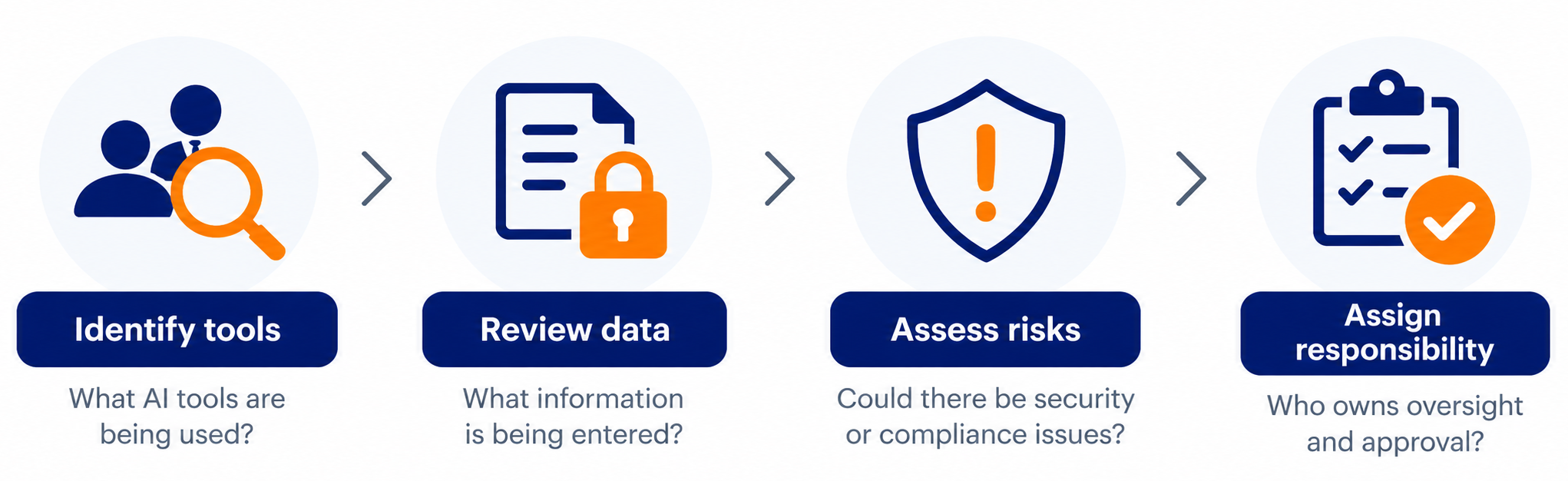
When organisations begin discussing AI governance, there’s often an assumption that new policies and controls need to be introduced immediately.
For businesses looking to understand their responsibilities under the EU AI Act, knowing which AI tools are already being used is a sensible starting point.
In reality, the first step is usually much simpler.
Take stock.
Find out which tools employees are using. Understand what problems those tools are solving. Look at the information being entered into them and identify whether any sensitive data could be involved.
You might discover AI is only being used in a handful of areas. Equally, you might find it’s become embedded across multiple departments without anyone having a complete overview.
This is also a good opportunity to review your existing IT setup and identify where additional security controls, guidance or improvements may be needed.
Either way, you’ll have a much clearer picture than you did before.
Clear guidance goes a long way
Preparing for the EU AI Act doesn’t have to mean introducing lengthy documents and complicated processes. Clear guidance on using AI responsibly is a good starting point.
Most employees want straightforward guidance. They want to know which tools are approved, what information can be shared and when they should seek advice before adopting something new.
Just as importantly, people need to understand that AI isn’t infallible.
Anyone who’s spent time using these tools will know they can occasionally produce inaccurate, incomplete or misleading results. Human judgement still matters, particularly when information is being shared externally or used to support business decisions.
The businesses seeing the greatest benefit from AI are usually the ones that treat it as a tool to support employees rather than replace critical thinking.
Don’t forget the technology you already have

One of the most common misconceptions about AI is that it’s something businesses buy separately.
Increasingly, that’s not the case.
AI is being built into platforms organisations already rely on every day. Microsoft 365, CRM systems, collaboration tools and customer service platforms are all introducing AI-powered features at a rapid pace.
As a result, many businesses are already using AI capabilities without actively seeking them out.
That’s why now is a good time to review permissions, access controls and data management practices. If employees can access information they shouldn’t see, AI-powered search and summarisation tools can sometimes make those issues more obvious.
Although not every AI feature will be subject to the same requirements under the EU AI Act, businesses should still understand what technology they’re using and how it handles information.
Good governance starts with good foundations.
Focus on the outcome, not the hype
There’s a tendency to talk about AI as though every organisation needs to adopt as much of it as possible.
In reality, the businesses getting the best results tend to be the ones taking a more measured approach.
Rather than asking, “How can we use more AI?”, they’re asking, “Where could AI genuinely help us work better?”
Sometimes the answer is customer service. Sometimes it’s reporting, administration or content creation. Sometimes it turns out that AI isn’t the right solution at all.
The goal isn’t to use AI for the sake of it. The goal is to solve problems, improve efficiency and support people in doing their jobs more effectively.
Keeping the EU AI Act in mind as part of your wider approach to AI governance can help ensure new technology is introduced responsibly.
How Elmdale IT can help

Understanding AI is one thing. Understanding how it fits into your existing IT environment is something else entirely.
At Elmdale IT, we help businesses take a practical approach to technology. That includes reviewing security, assessing data access, identifying potential risks and ensuring the right foundations are in place before new tools are rolled out.
A review of your existing systems can be a useful starting point. Our guide to preparing your business for an IT audit explains why understanding your current IT environment is important and what areas to consider.
Whether you’re exploring AI for the first time or reviewing how it’s already being used in light of the EU AI Act, we can help you make informed decisions about your IT environment, with security and long-term business goals in mind.
Get in touch with Elmdale IT to find out how we can help you build a secure, reliable IT environment that’s ready for the future.